Decoding the Data: What the Annual Security Report (ASR) Actually Tells You
On or before October 1st, universities across the nation release their Annual Security Report (ASR) as mandated by the Clery Act. For many parents, this 100+ page document is overwhelming. They flip immediately to the crime statistics tables, compare universities, and decide which is the safest.
As a Public Safety Executive who has overseen the production of these reports for a major university, I have found that the numbers rarely tell the whole story.
In fact, judging a campus solely by its crime statistics is one of the most common missteps a family can make. I have spent many hours with parents at "Open Houses" and information sessions where they show me the numbers with deep concern. I always offer as much context as possible, but I also direct them to the areas within the ASR that offer far more learning opportunities.
To honestly assess safety, you must learn to read the narrative, not just the spreadsheet.
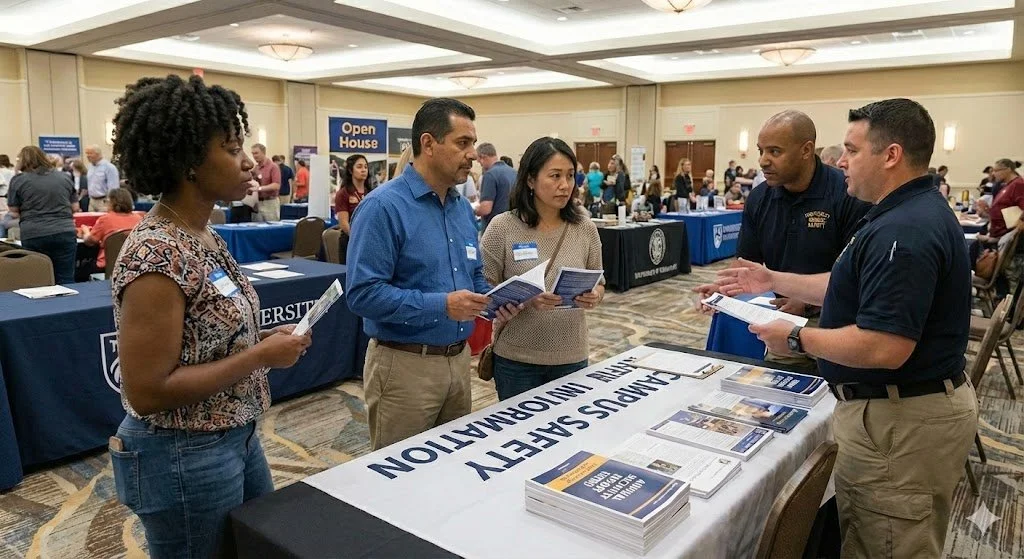
Parents at a university information session are talking with representatives from the public safety department.
What’s in a Number?
It is natural to assume that "Low Crime Numbers" equals "High Safety." However, in the nuance of higher education risk management, low numbers can sometimes signal low reporting rather than a crime-free environment.
Take sexual assault reporting, for example. If a university with 30,000 students reports zero sexual assaults in a year, that does not necessarily mean no assaults occurred. It often means there may be less confidence in reporting or a system that adds too much friction to the process.
Conversely, a university with higher numbers may be the safer choice. Why? Because those numbers indicate a robust reporting infrastructure, a trusting relationship between students and safety officials, and a culture of care with support systems in place. Transparency is a better metric than silence.
Go Beyond the Numbers
The Clery Act requires schools to disclose not just what happened, but how they are handling it. The accurate measure of a department’s competence lies in its policy descriptions and safety narratives.
When reviewing an ASR, I look for "The Three C’s":
Context: Does the report simply list the crime increase, or does it explain why it happened (e.g., "unattended scooters") and what the strategy is to fix it?
Capabilities: Does the report detail specific programs? A high-performing department doesn't just list "crime prevention"; they list specific initiatives like "Walking Escort Services," "Rape Aggression Defense (RAD) training," and "anonymous tip lines."
Collaboration: Are there mentions of partnerships with local law enforcement, the campus community, and the surrounding neighbors? As discussed in my previous articles, no campus is an island. The ASR should explicitly state the working relationships with municipal police and other stakeholders.
Key Communication: The "Timely Warning"
One section of the ASR I highly recommend reading is the policy on Timely Warnings and Emergency Notifications.
This section tells you how the university communicates when seconds count. Look for specifics:
Does the university commit to transparency during active threats?
Do they use multi-modal communication (text, email, sirens, app push notifications)?
Do they define clear criteria for when a warning is issued?
A vague policy here is a red flag. A clear, direct policy is a sign of a department that prioritizes information and student safety.
From Anxiety to Advocacy
For families, the ASR should be a conversation starter. When you visit a campus or speak to administrators, use the report to ask better questions:
"I noticed a rise in crime in the report. What specific mitigation strategies has the department implemented to address that trend?"
"Your report mentions a partnership with local police. How does that work operationally on a Friday night, and who is coming when a student calls 911?"
I have had parents ask me challenging questions, and I knew immediately they had read the ASR. I applaud parents who take the time to do this. I did the same thing when touring campuses as a parent.
Key Takeaway
Don't let the sheer volume of data paralyze you. The Clery Act is about more than statistics. The ASR is a window looking deeply into the university’s safety strategy. A safe campus does not hide its challenges; it identifies them, reports them transparently, and deploys strategic resources.