The Safety-Wellness Nexus: Why Mental Health is a Public Safety Imperative
For years, the norm was for campus safety and student counseling to operate separately. The counseling center focused on a student's mental well-being, while the police department focused on crime, incidents, and safety.
That outdated approach could dramatically increase risks.
Once Student Affairs and Public Safety began strong collaboration, a “new” strategic roadmap emerged. Responding to mental health shifted from public safety to public health.
As a Public Safety Executive, I have seen firsthand that the most significant risk lies within the disconnect between the Office of Student Affairs and the Department of Public Safety. I have also seen tremendous dedication from both offices to effect change. Traditionally, these vital functions share the same goals—student safety and success—but they have differing approaches. Now, they are coordinated goals with better outcomes.
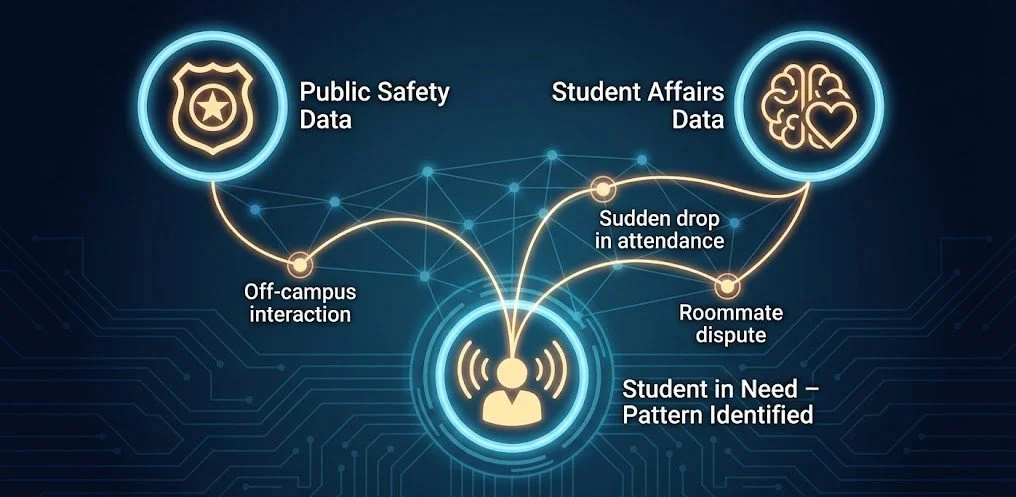
Image showing the connection between the Student Affairs, Public Safety, and the student in need.
The Blind Spots
A student in crisis often leaves "pixels" along the way. However, because departments often work in isolation, the whole picture is blurred:
Residential Life is involved in a roommate dispute.
Faculty notice a sudden drop in attendance or some obscure writing in an essay.
Public Safety may be aware of an off-campus interaction.
None of these scenarios, individually, triggers a high-level alert. But once the collaboration between departments begins, a clear pattern is identified. Had these departments not talked, the “blind spots” would continue to put the campus community at higher risk.
Operationalizing Care: Public Health Focused
In the past, when a university police officer responded to a student acting erratically in a dorm, the tools available were limited: a badge, a uniform, equipment, and enforcement. If the behavior was disruptive, the result was often an arrest or a conduct referral.
Sometimes enforcement is needed, but most of the time, the incident should be viewed through a mental health lens.
Crisis Intervention Team (CIT) Training is the bridge. CIT isn’t standard police training; it is specialized instruction by mental health professionals in conjunction with law enforcement training coordinators. The training shifts the mindset for officers to identify mental health signs and de-escalate the situation, usually ending with transportation to the hospital’s psychiatric center for evaluation, not jail.
The Dispatcher's Critical Role
Dispatchers play a crucial role because they receive the initial call for help. The call could be a disturbance, with yelling in the background. Ordinarily, a dispatcher would code this as a disturbance and relay the information to officers responding without any context.
Now, dispatchers are trained to ask callers key questions, triage the call, and direct officers to the scene. The dispatcher offers insight to the responding officers, who may now see this incident as a mental health crisis, arriving as a “guardian” rather than a “warrior”.
The CARE Team as a "Safety Net"
Operationally, the CARE Team (Crisis Assessment Response and Education) does more than just review cases. It creates coordinated, customized intervention strategies for our frontline officers.
When we identify a student struggling with mental health, we don't just file a report. We equip our officers with context. The CARE Team collaboration and CIT Training allow officers to respond appropriately to a student in crisis. This shifts the posture from “control” to “compassion.”
From Anxiety to Advocacy: Questions for Families
Parents often ask about blue-light phones, but rarely about behavioral intervention. When going through the college reviews and tours, families should ask questions that reveal how the school handles the safety-wellness nexus:
The Team Structure: "Does the university have a formal, multidisciplinary CARE or Behavioral Intervention Team that meets weekly?"
The Handoff: "If my student has a mental health crisis in a dorm, is the response purely law enforcement, or is there coordination with counseling staff?"
The Threshold: "How does the university connect academic struggles and behavioral outbursts?"
Key Takeaway
By integrating the CARE Team's intelligence with CIT tactics, we change the outcome. By training our dispatchers to triage and our officers to de-escalate, we ensure that a student’s worst day doesn't become a criminal record; it becomes a pathway to help.