The Blue Light Phone Paradox: Why "Old School" Infrastructure Still Matters in a Digital World
As funding resources become more challenging, one question inevitably arises regarding the line item for “Blue Light Emergency Phones” and their necessity on a modern campus.
I have been asked:
"Charlie, do we really need these? Every student has a smartphone. Let’s cut the maintenance costs and put that money into an app."
On the surface, this makes perfect sense. Why pay to maintain hardwired steel towers when every student carries a supercomputer in their pocket? If you look at the usage data, the number of genuine emergency calls from these phones has indeed dropped significantly over the last decade.
But as a Public Safety Executive, removing them is a strategic error.
Parent vs. Spreadsheet
While administrators look at the low usage numbers, parents look at the environment. One of the most common questions I fielded at open houses was, "Does your campus have those Blue Light Emergency Phones?" or they would remark with relief, "I noticed the Blue Lights while walking around campus."
The Blue Lights are more than a “feel-good” prop for parents. They are a critical layer of redundancy and deterrence that an app simply cannot replicate.
The Fallacy of the "Always-On" Student
The argument for removing physical phones rests on the assumption that a student’s personal device is always charged, always has a signal, and is always in their possession.
In the real world of campus life, those assumptions fall short every day.
The Dead Battery: It is 2:00 AM on a Saturday. A student is walking home, and their phone died an hour ago. As a parent and a Chief, I saw firsthand that college students often let their battery drop to a single digit before realizing they need to charge. Without Blue Light phones, they are cut off from safety communication.
The Victim Scenario: In many robberies and thefts, the phone is the first item taken. If we dismantle our physical infrastructure, we leave that student with absolutely no way to signal for help.
We cannot build a safety strategy that relies 100% on a device the university does not control.
From Static to Dynamic: The Hybrid Model
The solution is not to remove the Blue Light Phones, but to evolve them. During my time at Temple University, we realized these weren't just phones—they were pre-wired, strategically placed assets with power and data connectivity.
We stopped viewing them as "payphones" and began treating them as force multipliers.
1. The "Real-Time" Broadcast System
We integrated our Blue Phones into our mass notification system. Instead of just receiving calls, they could broadcast warnings.
During a shelter-in-place drill, we tested this multi-modal approach. While students in classrooms received text messages, students walking outside—who might not be looking at their screens—heard the emergency voice message booming from the Blue Light speakers.
That is a capability an app cannot match: immediate, passive notification for anyone in the vicinity.
2. The Visual Deterrent (Cameras)
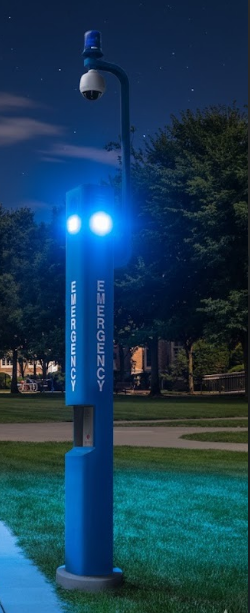
A Blue Light phone is already highly visible. In partnership with the VP of Telecommunications, we collaborated on an initiative to mount security cameras directly onto the Blue Light towers.
This served a dual purpose. First, it utilized existing infrastructure, saving installation costs. Second, it turned the towers into active guardians. A criminal might not notice a camera tucked under a building eave, but they will undoubtedly see one perched atop a glowing blue beacon.
The Digital Handshake
This doesn't mean we ignore mobile technology. Apps like RAVE Guardian (now RAVE AppArmor), LiveSafe, and Temple’s own TUSAFE (built on the AppArmor platform) are excellent tools. They allow for "virtual escorts," quick tips, and emergency connection with police dispatchers.
But in a comprehensive safety strategy, digital tools should complement physical infrastructure, not replace it.
When a student sees a Blue Light Phone, they see a physical manifestation of the university’s commitment to their safety. It says, "We are ready, and we are here to protect you."
Key Takeaway
A "Smart Campus" isn't just about software. It is a hybrid environment where steel and digital work together. Before you cut the budget for physical infrastructure, ask yourself: If a student is standing alone in the dark with a dead battery, what is your backup plan?